Charleston Area EV Charging Specialists
EV Charger Installation in Charleston, SC
Bought an EV and not sure what you need at home? More Miles EV helps homeowners and businesses pick the right charger, confirms whether the electrical system can support it, installs it properly, and coordinates the permit and inspection. You do not need to understand amps, panels or load calculations — that is our job.
Homes and businesses · Bring your own charger or let us supply one · Tesla and other major compatible brands
Home EV charger installation in Charleston, Berkeley and Dorchester counties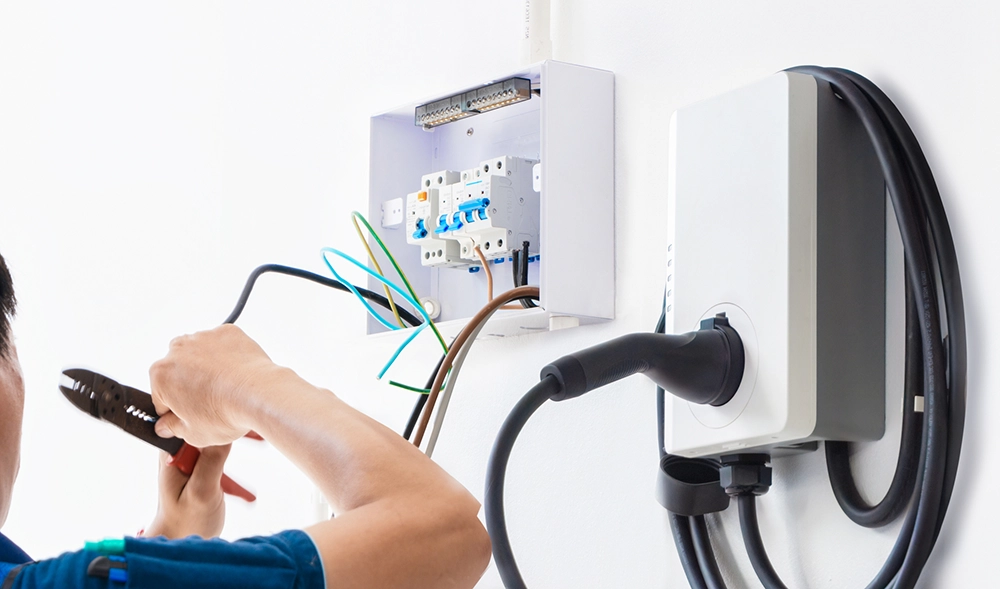
EV charging specialists
Chargers are what we do all day
Licensed electrical professionals
Permitting and inspection coordination included
2-year workmanship warranty
On the work we install
Transparent pricing
Clear scope before we start
How it works
Four steps from question to charged car
- 1
Tell us about your EV and property
A few simple questions and a couple of photos of your panel and parking spot. No technical homework on your end.
- 2
We recommend the charging setup
Which charger, what circuit size, where it should go, and whether any panel or load-management work is needed.
- 3
You receive a clear estimate
Transparent scope, what is included, and the typical next steps — reviewed with you before any work starts.
- 4
We install, document and coordinate inspection
You get photos and documentation of the finished work, and we correct install-related inspection issues under our workmanship policy.
Where we work
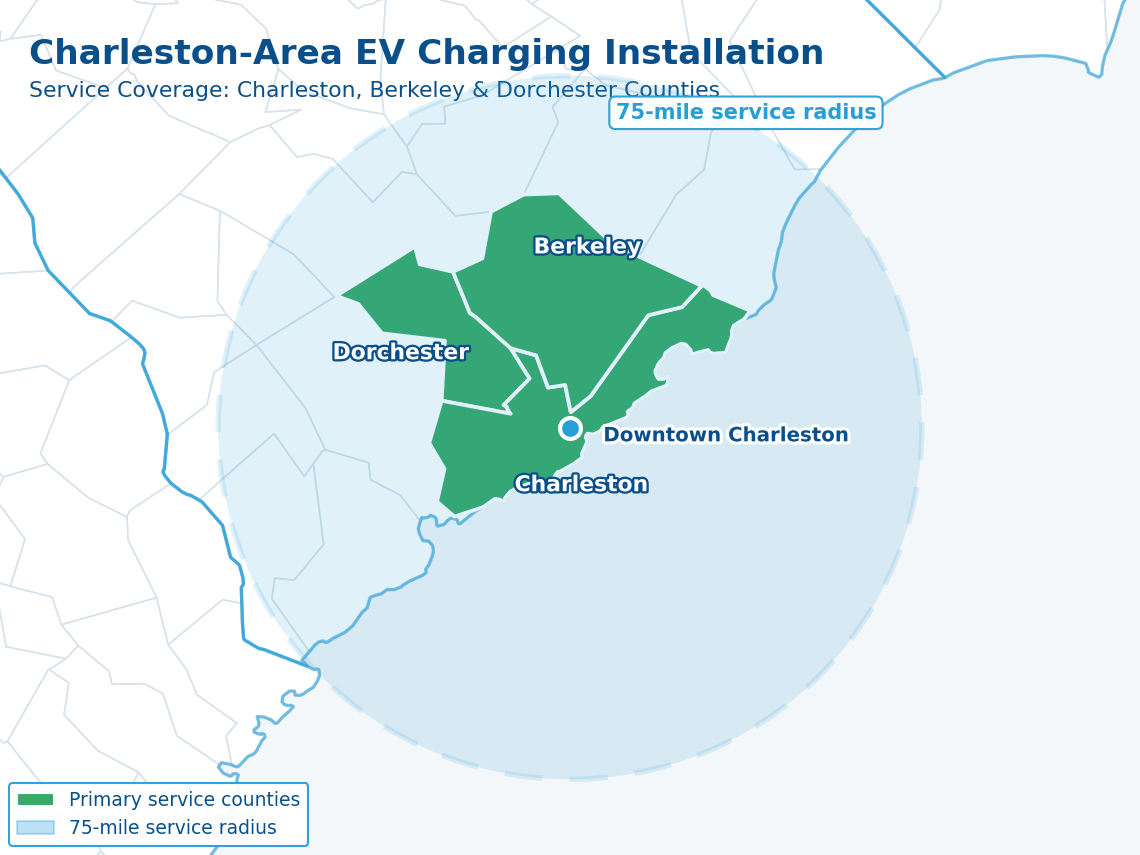
Serving the Charleston region
Our primary service area is Charleston County, Berkeley County and Dorchester County. That covers Charleston, Mount Pleasant, North Charleston, Summerville, Goose Creek, Moncks Corner, James Island, Johns Island and the surrounding communities.
Projects outside these three counties are evaluated individually — call us and we will tell you honestly whether we are a good fit.
Transparent pricing
How much does residential EV charger installation typically costs?
These are planning ranges to help you budget — not binding quotes. Your written estimate comes after we look at your specific setup.
Residential Level 2 installation
A standard home Level 2 charger installation.
$1,000–$2,000typical range
- Charger placement and circuit sizing
- Panel and load assessment
- Permit and inspection coordination
- Completed-work photos
Electrical panel upgrade
Only when the load calculation shows your home truly needs it.
$3,000–$5,000typical range, when required
- Load calculation and service review
- Utility and permit coordination
- Alternatives considered first, including load management
Commercial multi-unit projects
Multifamily, workplace, retail, hospitality and fleet charging.
$5,000–$30,000+typical range
- Site evaluation and capacity planning
- Multi-station layout and future expansion
- Permitting and inspection coordination
Final price depends on the distance from the panel to your parking spot, trenching or conduit, available panel capacity, which charger hardware you choose, permitting, any service upgrade, and overall site complexity. See what drives installation cost.
The question everyone asks first
Do I really need Level 2 charging?
Most new EV owners start by plugging into a standard 120V household outlet with the mobile connector that came with the car. That works, and for a short commute it may be all you ever need.
The catch is pace. A standard wall outlet adds range slowly, so a busy day of driving can take more than one night to replace. A professionally installed 240V Level 2 setup usually replaces a normal day's driving comfortably overnight, so you start every morning full without thinking about it.
One clarification worth making: not every mobile connector is limited to 120V. Some can charge at 240V when a suitable outlet exists. The real comparison is standard 120V charging versus a properly installed 240V Level 2 circuit sized for your car and your home.
No technical homework required
What does More Miles EV figure out for you?
You tell us about the car and where you park. We work out the rest and explain it in plain English.
Your EV and how you drive
What you drive, how far you go on a normal day, and when the car sits parked.
Your electrical service and panel
What size service you have today and how much room is actually left in the panel.
Available capacity
A load calculation tells us what your home can safely support — no guessing.
Distance and route to your parking spot
How far the wire has to travel from the panel, and the cleanest way to get it there.
Where the charger goes
Inside a garage, outdoors, or a detached garage — each changes the approach.
Hardwired or plug-in
We recommend the option that fits your charger, your location and the code.
Whether load management can help
Smart load sharing often lets a home add charging without a bigger panel.
Whether a panel upgrade is truly needed
Many homes do not need one. If yours does, we explain exactly why before you spend.
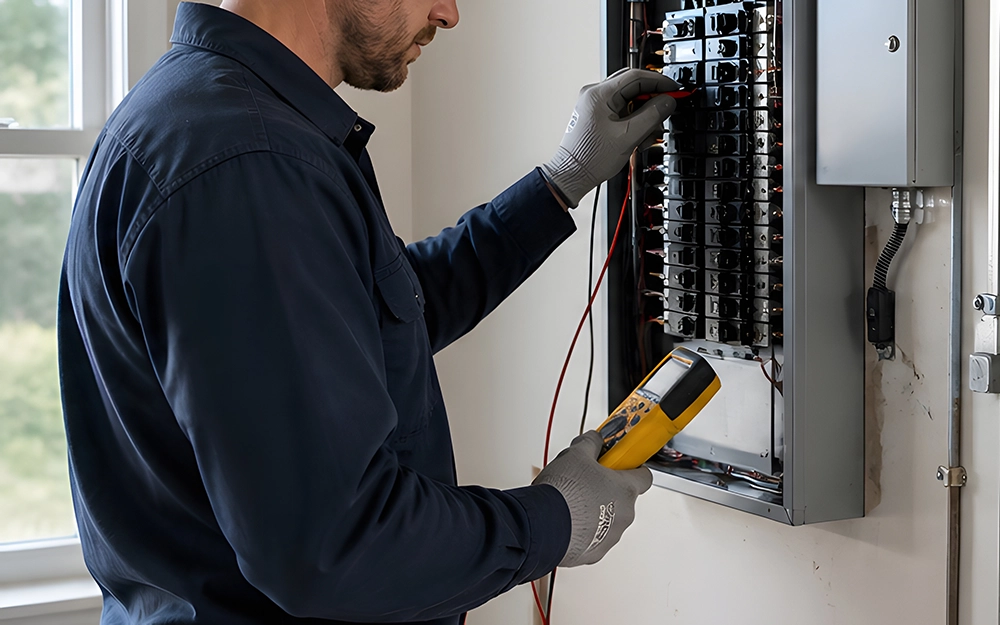
Many homes do not need a panel upgrade
A charger can often be set to a lower current, or share capacity with load management, and still charge fully overnight. We only recommend a panel upgrade when the numbers genuinely call for one — and we show you why.
How panel capacity worksTwo kinds of projects
Home charging and business charging
Residential EV charging
A charger at home, installed once and done right, so the car is ready every morning.
- • Level 2 charger installation
- • Tesla Wall Connector and other major brands
- • Panel and load assessment before we quote
- • Hardwired, or a NEMA 14-50 outlet where that fits better
- • Outdoor and detached garage installations
- • Second charger and future-proofing planning
Commercial EV charging
Charging that has to work for tenants, staff, guests and vehicles — and grow later.
- • Multifamily, workplace, retail, hospitality and fleet
- • Level 2 deployments and qualified DC fast-charging projects
- • Site assessment and electrical capacity planning
- • Permitting and inspection coordination
- • Scalable layouts that allow adding stations later
Charger compatibility
Your charger, or one we supply
We install all major compatible EV chargers. If you already bought one, we will install it. If you would rather not choose, we will supply the hardware and explain the trade-offs in a couple of sentences.
For most customers we lean toward the Tesla Wall Connector and ChargePoint for quality and value, but you are not limited to them — other major compatible EV chargers are welcome too.
Installed right. The first time.
What stands behind the work
An EV charger is a permanent part of your electrical system. Here is exactly what you can expect from us after the truck leaves.
- 2-year workmanship warranty on our installation work.
- Manufacturer equipment warranty passes through to you.
- We aim to respond to workmanship concerns within 1 business day.
- No-charge correction of defects caused by our installation.
- Free correction of inspection issues caused by our installation work.
- Photos and documentation of the completed work.
FAQ
EV charging questions, answered simply
Short answers first. Open Read More when you want the full detail.
- Do I really need a Level 2 charger at home?
- Not everyone does, but most drivers are much happier with one. Level 2 replaces a normal day's driving overnight, while a standard 120V outlet can take more than one night to catch up.
- How much faster is Level 2 charging than a regular wall outlet?
- A standard 120V outlet delivers roughly 1.4–1.9 kW, often about 3–5 miles of range per hour. Level 2 setups typically deliver about 7.7 kW at 32A, 9.6 kW at 40A, or 11.5 kW at 48A.
- Can I use the charger that came with my EV?
- Often yes. Many vehicles include a mobile connector, and some of those can charge at 240V with the right outlet — we will tell you what yours supports.
- Does my electrical panel need to be upgraded?
- Many homes do not need an upgrade. A load calculation tells us how much capacity is actually available, and lower charger settings or load management often solve the gap.
- Is hardwired or plug-in EV charging better?
- Hardwired is the cleaner, more permanent choice and is often required outdoors or at higher currents. Plug-in on a NEMA 14-50 outlet adds flexibility if you may move or swap the charger.
- How much does home EV charger installation cost in Charleston?
- Residential Level 2 installations typically run about $1,000–$2,000. If a panel upgrade is required, that is usually about $3,000–$5,000 more. These are planning ranges, not quotes.
- Can you install a charger outdoors or in a detached garage?
- Yes. Outdoor and detached-garage installations are common here — they just need weather-rated equipment and a properly protected route for the wiring.
- Can you install Tesla and other charger brands?
- Yes. We install the Tesla Wall Connector, ChargePoint, and other major compatible EV chargers — hardware we supply or equipment you bought yourself.
- Do you handle permits and inspections?
- Yes. We coordinate the permitting and inspection process for your installation, so you are not the one calling the building department.
- How long does an EV charger installation take?
- Many straightforward residential installations can be completed in a single scheduled visit. More involved projects take longer.
Charleston based
A local company built around one problem
More Miles EV exists to fix something simple: buying EV charging should not feel confusing. Instead of being a general electrician who occasionally installs chargers, we specialize in EV charging for homes and businesses across the Charleston region — so the recommendation you get is the one we would choose for our own driveway.
More about More Miles EV- Based in
- Charleston, SC 29407
- Hours
- Monday–Friday, 9:00 AM–5:00 PM
- Focus
- Charleston, Berkeley and Dorchester counties
Ready to Stop Waiting on a Wall Outlet?
Plug in at night, wake up with a full battery, and stop planning your week around charging. Tell us about your EV and where you park, and we will figure out the right setup for your home or business.
(843) 508-9061 · Monday–Friday, 9:00 AM–5:00 PM
Related pages