EV Charging Basics
Level 1 vs. Level 2 EV Charging: What's the Difference?
Level 1 charging uses a standard 120V household outlet and adds range slowly. Level 2 uses a dedicated 240V circuit and is much faster. Which one is right for you depends on how far you drive each day, what your vehicle can accept, and what your home's electrical system can support.
No jargon, no pressure — just the comparison, and an honest answer about which one fits your driving.
Side by side
Level 1 vs. Level 2 at a Glance
The whole comparison in one place. Power and range figures are illustrative, because real-world speed depends on your vehicle and your circuit.
| Level 1 (120V) | Level 2 (240V)Recommended | |
|---|---|---|
| Voltage | 120V standard household outlet | 240V dedicated circuit |
| Typical power | About 1.4–1.9 kW | About 7.7 kW at 32A, 9.6 kW at 40A, 11.5 kW at 48A |
| Typical charging use | Slow top-ups over long overnight periods | Full overnight recovery for normal daily driving |
| Approximate range added per hour, where supportable | Often roughly 3–5 miles | Several times faster — the exact figure depends on your EV's onboard charger |
| Best fit | Low-mileage drivers, plug-in hybrids, cars parked at home for many hours | Typical or higher daily mileage, larger batteries, two-EV households |
| Electrical work required | Usually none if a suitable, safe existing outlet is available near where you park | Load assessment, dedicated 240V circuit, proper installation and inspection coordination |
| Overnight recovery | Limited — a large deficit can take more than one night | Usually replaces a normal day's driving overnight |
| Portability and flexibility | Portable connector travels with you easily | Wall-mounted unit stays put; a plug-in setup keeps the charger removable |
| Panel capacity impact | Minimal, though the existing circuit's loading still matters | Meaningful — capacity is confirmed by a load calculation, not by empty breaker spaces |
| Cost to install | Usually minimal when a suitable, safe existing outlet is already available; new dedicated outlet or circuit work adds cost and must be quoted for the home | Typically $1,000–$2,000, plus $3,000–$5,000 if a panel upgrade is genuinely required |
Level 1 (120V)
- Voltage
- 120V standard household outlet
- Typical power
- About 1.4–1.9 kW
- Typical charging use
- Slow top-ups over long overnight periods
- Approximate range added per hour, where supportable
- Often roughly 3–5 miles
- Best fit
- Low-mileage drivers, plug-in hybrids, cars parked at home for many hours
- Electrical work required
- Usually none if a suitable, safe existing outlet is available near where you park
- Overnight recovery
- Limited — a large deficit can take more than one night
- Portability and flexibility
- Portable connector travels with you easily
- Panel capacity impact
- Minimal, though the existing circuit's loading still matters
- Cost to install
- Usually minimal when a suitable, safe existing outlet is already available; new dedicated outlet or circuit work adds cost and must be quoted for the home
Level 2 (240V)Recommended
- Voltage
- 240V dedicated circuit
- Typical power
- About 7.7 kW at 32A, 9.6 kW at 40A, 11.5 kW at 48A
- Typical charging use
- Full overnight recovery for normal daily driving
- Approximate range added per hour, where supportable
- Several times faster — the exact figure depends on your EV's onboard charger
- Best fit
- Typical or higher daily mileage, larger batteries, two-EV households
- Electrical work required
- Load assessment, dedicated 240V circuit, proper installation and inspection coordination
- Overnight recovery
- Usually replaces a normal day's driving overnight
- Portability and flexibility
- Wall-mounted unit stays put; a plug-in setup keeps the charger removable
- Panel capacity impact
- Meaningful — capacity is confirmed by a load calculation, not by empty breaker spaces
- Cost to install
- Typically $1,000–$2,000, plus $3,000–$5,000 if a panel upgrade is genuinely required
Direct answer
Which Is Better: Level 1 or Level 2?
Neither is universally better. Level 1 can be the better choice for low-mileage drivers because it is simple and uses infrastructure the home already has. Level 2 is usually better when you need dependable overnight recovery, drive a larger-battery EV, have a longer commute, run two EVs, or want fewer public charging stops.
The honest test is whether your car regains as much range at home as you use over a normal week. If it does, a standard outlet is doing its job. If it does not, that gap is the reason to consider Level 2 — not the fact that a bigger number exists.
Level 1 is best for…
- Low daily mileage — the car only needs a small amount of range back each night.
- A plug-in hybrid with a small battery that refills quickly.
- Long dwell time at home: the car is parked for many hours every night.
- A suitable, safe existing outlet is already available near where you park.
- You have convenient charging elsewhere, at work or nearby.
Level 2 is best for…
- Typical or higher daily driving, where a wall outlet steadily falls behind.
- A larger-battery EV, where recovering a big deficit at 120V takes days.
- Two EVs sharing the same home and the same overnight window.
- An unpredictable schedule, where you want the car ready whenever you leave.
- You are paying for public fast charging mainly because home charging is slow.
The slow, simple option
How Level 1 Charging Works
Level 1 charging means plugging into a regular 120V household outlet, usually with the portable connector that came with the car. It delivers about 1.4–1.9 kW, which often works out to roughly 3–5 miles of range per hour.
- No new equipment is needed when a suitable outlet already exists near where you park.
- It works best with long dwell time — a car parked at home all night has many hours to catch up.
- It suits low-mileage drivers and plug-in hybrids with small batteries especially well.
- The single biggest limitation is recovery speed. Once you use more range in a day than the outlet can return overnight, you fall behind.
- Outlet condition, circuit loading and suitability still matter. Charging pulls a steady load for hours, so an old, damaged or heavily shared outlet is worth having checked — and extension cords or improvised setups are not an acceptable substitute.
The dedicated option
How Level 2 Charging Works
Level 2 charging runs on a dedicated 240V circuit installed for the charger alone. The common planning points for homes are 32A, 40A and 48A — about 7.7 kW, 9.6 kW and 11.5 kW respectively.
- It is dramatically faster than Level 1, which is what makes reliable overnight recovery possible.
- The charger may be hardwired or plug-in, depending on the equipment, the location and the applicable code.
- Installation involves an electrical assessment, correct circuit sizing, proper installation and testing, and inspection coordination where applicable.
- Actual speed is capped by your vehicle's onboard AC charger. A larger circuit does not make a car charge faster than it is built to.
Recovery speed
How Much Faster Is Level 2?
In plain English: a standard 120V outlet may need one or two days to recover a large amount of range, while Level 2 can often restore a normal day's driving overnight.
We compare power rather than promising charging times, because the same installation behaves differently on two different cars. Once we know what you drive, we can talk about your vehicle specifically.
Typical home charging power
Illustrative figures for comparing setups — not a promise for a specific vehicle.
- Level 1 — standard 120V outletAbout 1.4–1.9 kW
Often roughly 3–5 miles of range per hour
- Level 2 — 32A circuitAbout 7.7 kW
A comfortable overnight setup for many drivers
- Level 2 — 40A circuitAbout 9.6 kW
Often suits larger batteries or longer commutes
- Level 2 — 48A circuitAbout 11.5 kW
The fastest common home setup, where the panel and the vehicle both support it
Actual charging speed depends on your EV's onboard AC charger, battery size, starting state of charge, circuit capacity, the charger itself and efficiency. Not every vehicle or home supports 48A.
Examples, not promises
Which Level Fits How You Actually Drive?
These four sketches are illustrative examples to help you place yourself, not calculations or guarantees. Your own result depends on your vehicle, your battery size and your habits.
Short commute — around 15–20 miles a day
Level 1 may be enough
A standard outlet plugged in every evening will often replace this kind of daily use overnight. If that is your pattern and the outlet is safe and suitable, there may be no reason to change anything.
Typical daily driving — around 30–50 miles a day
Level 2 becomes more convenient
This is where 120V charging starts to feel tight, especially after a busier day or a weekend trip. Level 2 turns overnight recovery into something you can rely on rather than something you watch.
Long commute — 60+ miles a day
Level 2 often makes more sense
At this mileage a standard outlet frequently cannot keep pace across a working week, and the shortfall accumulates. A properly sized 240V circuit is usually the practical answer.
Two EVs in one household
Level 2 is usually far more practical
Two cars sharing the same overnight hours rarely both catch up on 120V. One shared Level 2 charger, two stations, or power sharing where the equipment supports it all solve this better.
We deliberately avoid publishing exact hours for these scenarios. Battery size, starting state of charge, onboard charger limits and efficiency change the answer enough that a precise figure would be misleading.
Common misunderstanding
Is the Charger That Came With My EV Level 1?
Sometimes yes, sometimes no. Some mobile connectors are 120V only. Others support 240V with the proper adapter and a properly installed outlet, which means they can operate at Level 2 speeds.
"Level 1" and "Level 2" describe the supply the equipment is connected to, not the brand of cable in your trunk. The equipment's own rating and the voltage it is plugged into together determine which one you are using.
So before assuming you need to replace anything, check your vehicle documentation — or send us a photo of the connector and its label and we will tell you what it can do. If it already supports 240V and meets your needs, keeping it is a perfectly legitimate plan. What still has to be right is the outlet and the circuit behind it.
What decides Level 1 or Level 2
- The equipment rating
- Some connectors are built for 120V only; others are rated for both 120V and 240V operation.
- The supply voltage
- A dual-voltage connector on a 120V outlet is charging at Level 1. The same connector on a properly installed 240V outlet is charging at Level 2.
- The circuit behind the outlet
- A 240V receptacle used for EV charging should be correctly specified and installed on its own circuit.
Sized, not oversold
Your EV Decides the Maximum AC Charging Speed
Every EV has an onboard AC charger that sets a ceiling on home charging speed. If you install a circuit bigger than the car can use, nothing charges faster — you have simply paid for capacity the vehicle will never draw.
That is why we start from your vehicle rather than the biggest available number. 32A, 40A and 48A are examples of common planning points, not recommendations that apply to every car or every home. Plenty of vehicles cannot use 48A, and plenty of homes cannot support it.
Where a future vehicle might use more, a charger with adjustable current gives you headroom without redoing the wiring later.
Common Level 2 planning points
- 32A — about 7.7 kW
- Enough for many drivers, and often the practical answer where panel headroom is limited.
- 40A — about 9.6 kW
- A middle ground that suits larger batteries and longer daily distances.
- 48A — about 11.5 kW
- The fastest common home option — worth it only when both the vehicle and the electrical service support it.
If your car cannot use 48A, we will tell you rather than sell it to you.
Panel capacity
Can My Electrical Panel Support Level 2?
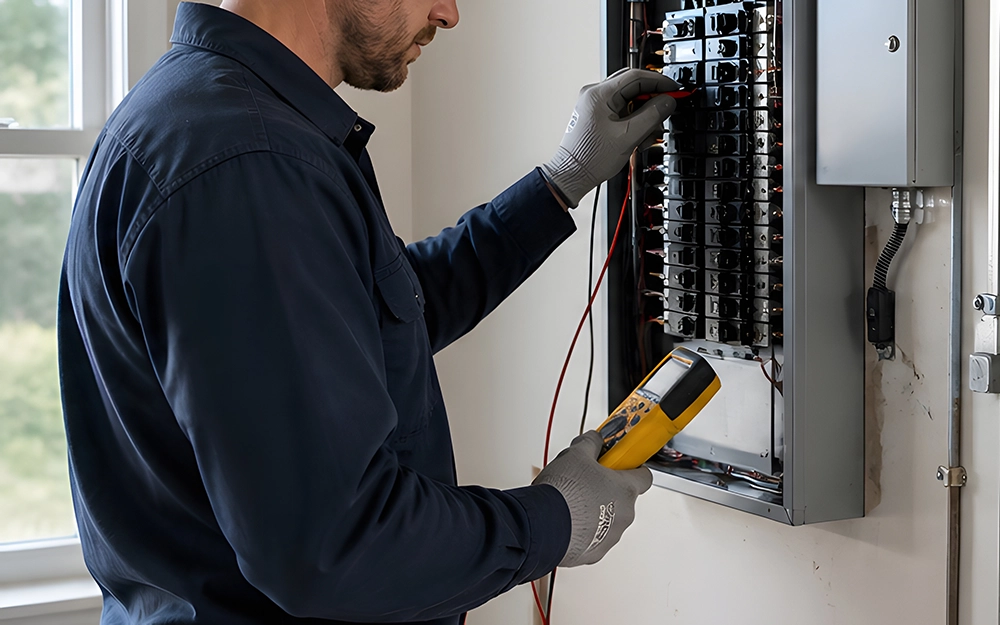
Often, yes. Many homes across the Charleston area can support a Level 2 charger exactly as they are. The only reliable way to know is a load calculation — and that is our job, not yours.
Empty breaker spaces are not the same as available capacity. A panel can have room for more breakers while the service is already close to fully allocated, and it can look full while capacity remains. The calculation decides, not the appearance.
When capacity is tight, a lower-current Level 2 circuit is still a big improvement over a standard outlet, and load management or power sharing can sometimes avoid a panel upgrade entirely. We recommend an upgrade only when it is genuinely necessary — and if it is, we explain exactly why.
Connection method
Hardwired or Plug-In Level 2?
A fit question, not a quality question. We recommend based on your charger, the location, the current involved and the applicable code.
| Hardwired | Plug-in (NEMA 14-50) | |
|---|---|---|
| Connection | Permanently wired to the dedicated circuit | Plugs into a properly installed 240V outlet |
| Look and feel | Typically the tidiest, most built-in result | Visible outlet and plug at the wall |
| Flexibility | Stays with the house | Removable — easy to swap, take with you, or use a portable connector |
| Outdoor and higher-current use | Often preferred or required, depending on equipment and code | Possible with equipment and an outlet rated for the conditions |
| Connection points | Fewer plug and receptacle connection points | Outlet must be correctly specified and installed |
Hardwired
- Connection
- Permanently wired to the dedicated circuit
- Look and feel
- Typically the tidiest, most built-in result
- Flexibility
- Stays with the house
- Outdoor and higher-current use
- Often preferred or required, depending on equipment and code
- Connection points
- Fewer plug and receptacle connection points
Plug-in (NEMA 14-50)
- Connection
- Plugs into a properly installed 240V outlet
- Look and feel
- Visible outlet and plug at the wall
- Flexibility
- Removable — easy to swap, take with you, or use a portable connector
- Outdoor and higher-current use
- Possible with equipment and an outlet rated for the conditions
- Connection points
- Outlet must be correctly specified and installed
Neither is universally better. The longer explanation, including where each one tends to win, is on our home EV charger installation page.
Planning numbers
What Does Each One Cost?
Transparent planning ranges to help you budget. Your written price comes after we see your panel, your parking spot and the distance between them.
Level 2 home installation
Covers most straightforward residential Level 2 installations.
$1,000–$2,000typical planning range
- Panel and service assessment
- Charger and circuit sizing for your vehicle
- Dedicated 240V circuit installation
- Testing, configuration and documentation
- Permitting and inspection coordination as applicable
Electrical panel upgrade
Recommended only when a load calculation shows it is genuinely needed — many homes do not need one.
$3,000–$5,000typical planning range, only if required
What about Level 1?
When a suitable, safe existing outlet is already available near where you park, Level 1 usually involves little to no installation cost — you are using infrastructure the home already has.
That is not the same as free. If a new dedicated outlet or circuit is needed, if the existing outlet is not in good condition, or if the run has to reach a detached garage or driveway, that is electrical work and it has to be quoted for the home. We do not publish an average Level 1 installation price, because there is no honest single figure for it.
For Level 2, the main cost drivers are the distance from panel to charger, conduit or trenching, available panel capacity, the charger hardware, permitting, and whether a service upgrade is needed.
Practical checklist
When Should I Upgrade From Level 1 to Level 2?
There is no score and no algorithm here — this is simply the list we work through with homeowners on the phone. If several of these describe your situation, Level 2 is worth discussing.
And if Level 1 already keeps up with the way you drive, there may be no urgency at all. We would rather tell you that than sell you a circuit you do not need.
Signs it is time
- Your car is not fully recovering overnight on a normal night.
- You are relying on public fast charging to make up the gap.
- Your daily driving has increased since you bought the car.
- A second EV has joined the household.
- You have moved to a larger-battery EV.
- You want a predictable state of charge every morning.
- Charging at work or at nearby public stations has become less convenient.
How it works
Four Steps, and We Handle the Technical Part
You send simple information and a couple of photos. We take care of the sizing, the code and the paperwork.
- 1
Tell us your EV and your property
Make, model, and whether you park in a garage, carport, driveway or detached garage.
- 2
Send panel and parking photos
A photo of your electrical panel and one of where you park tells us most of what we need.
- 3
We recommend the setup
Charger, circuit size and placement matched to what your car can accept and your panel can support — in plain English.
- 4
We install, test and document
Dedicated 240V circuit, real charging verified, work photographed, permitting and inspection coordinated as applicable.
Where we work
Home Charging Across the Tri-County
We install Level 2 home charging throughout Charleston, Berkeley and Dorchester counties — from downtown Charleston and Mount Pleasant to North Charleston, Summerville, Goose Creek and Moncks Corner.
Housing age, panel condition, permitting jurisdiction and outdoor exposure all differ across the region, so we plan for the home in front of us.
Charleston County
Berkeley County
Dorchester County
FAQ
Level 1 vs. Level 2 Questions We Hear Most
Short answers you can use right away, with the full explanation one click behind each one.
- What is the main difference between Level 1 and Level 2 charging?
- Level 1 uses a standard 120V household outlet and charges slowly. Level 2 uses a dedicated 240V circuit and charges several times faster.
- How much faster is Level 2 than Level 1?
- Several times faster. Level 1 delivers roughly 1.4–1.9 kW, while Level 2 typically delivers about 7.7 kW, 9.6 kW or 11.5 kW depending on the circuit.
- Can Level 1 be enough for daily driving?
- Yes, for many low-mileage drivers. If a standard outlet replaces what you use each day while the car is parked overnight, Level 1 is doing its job.
- Is the charger that came with my EV Level 1 or Level 2?
- It depends on the equipment. Some mobile connectors are 120V only, while others support 240V with the proper adapter and outlet, which makes them Level 2.
- Does Level 2 require a special electrical circuit?
- Yes. Level 2 charging needs a dedicated 240V circuit, correctly sized for the charger and installed for continuous use.
- Can my existing electrical panel support Level 2?
- Often yes. A load calculation confirms what capacity your service really has — empty breaker spaces are not the same as available capacity.
- Is 48A always better than 32A or 40A?
- No. A bigger circuit only helps if your vehicle's onboard charger can use it and your electrical service can support it.
- Is hardwired Level 2 better than plug-in Level 2?
- Neither is universally better. Hardwired is permanent and tidy with fewer connection points; plug-in keeps the charger removable and flexible.
- How much does it cost to upgrade from Level 1 to Level 2?
- Most residential Level 2 installations fall in a typical planning range of $1,000–$2,000, plus $3,000–$5,000 if a panel upgrade is genuinely required.
- When should I upgrade from Level 1 to Level 2?
- When your car stops fully recovering overnight, or you start using public fast charging to make up the gap. If Level 1 keeps up, there is no urgency.
Charge at Home Without Waiting All Day.
If Level 1 keeps up with the way you drive, keep using it — that is a genuinely reasonable setup. If it does not, we will size a Level 2 installation to your car and your home rather than overselling capacity you will never use. Tell us what you drive and where you park, and we will take it from there.
(843) 508-9061 · Monday–Friday, 9:00 AM–5:00 PM
Related pages