EV Charger Installation Services in Charleston, SC
We take on residential and commercial charging projects from start to finish: choosing the right charger, checking whether your electrical system can support it, installing it, coordinating permits and inspection, handling upgrades and repairs, and leaving room to add more charging later.
Bring your own charger or let us supply one · Tesla and other major compatible brands
Direct answer
What EV Charging Services Do We Provide?
More Miles EV installs, upgrades, repairs and relocates EV charging systems for homes and businesses across Charleston, Berkeley and Dorchester counties. That includes the electrical work behind the charger — capacity assessments, circuits, panel upgrades and load management — plus permitting and inspection coordination as applicable.
When the load calculation genuinely calls for more capacity, we handle or coordinate it.
Load calculations and capacity assessments
We measure what your electrical system can actually support before recommending anything.
Load management solutions
Smart capacity sharing that often lets you add charging without replacing the panel.
Permitting and inspection coordination
We handle the paperwork and scheduling with the local authority, as applicable.
Charger maintenance and repair
Diagnosis of charging interruptions, circuit concerns and visible installation issues.
Charger removal and relocation
Moving, replacing or removing an existing charger — including before a move or remodel.
Second charger and future expansion
Planning now for a second EV, so the next charger is a small job instead of a big one.
New construction and builder coordination
Conduit, capacity and charger locations planned before walls and driveways are finished.
For homes
Residential EV Charger Installation
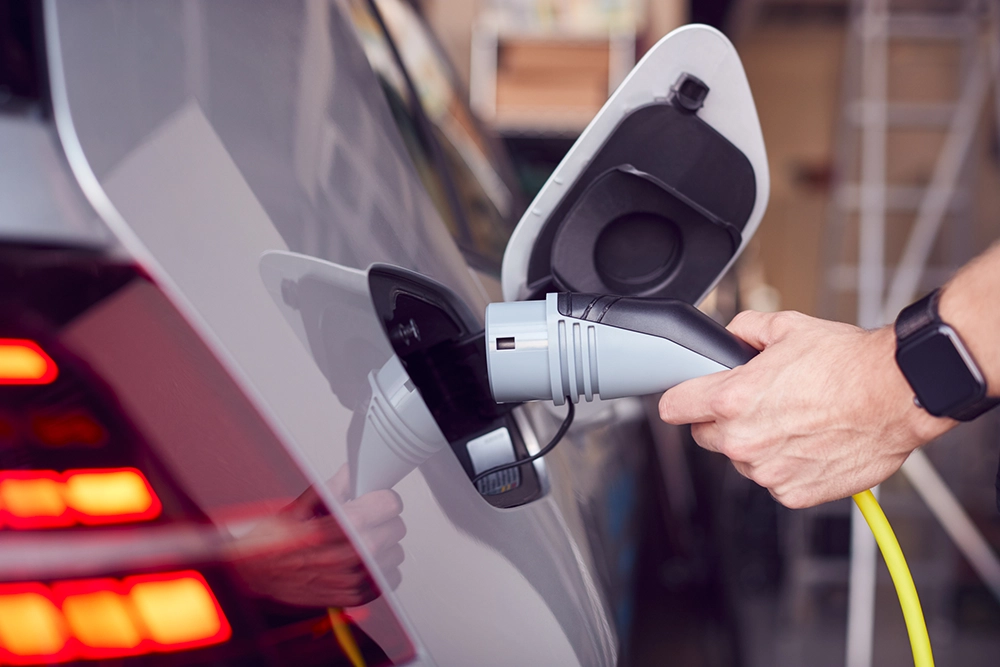
Plug in when you get home, wake up full. That is the whole point of a home charger, and it only works if the electrical side is done properly.
A home installation starts with a dedicated 240V circuit sized for your vehicle and your panel — not simply the largest number available. Some cars cannot accept the full output of a 48A circuit, so paying for one is money spent on nothing.
From there we recommend whether the charger should be hardwired or plugged into a 240V outlet such as a NEMA 14-50. Hardwiring is tidier, permanent, and often the right answer outdoors or at higher currents. A plug-in setup is easier to unplug, swap or take with you if you may move.
We install the Tesla Wall Connector and other major compatible chargers, whether you already bought the equipment or would rather we supply it. Garage, carport, exterior wall or a detached garage across the yard — each has a different route for the wiring, and we price that honestly up front instead of discovering it on install day.
If a second EV is likely, say so early. Planning capacity for two chargers now is far cheaper than reworking it later. And before we ever suggest a panel upgrade, we run the load assessment — many homes simply do not need one.
Level 2 charger installation for houses, townhomes and condos
Dedicated 240V circuit planning sized to your vehicle
Hardwired or plug-in, including NEMA 14-50 outlets
Tesla Wall Connector and other major compatible brands
Customer-supplied or More Miles EV-supplied hardware
Indoor garage, outdoor and detached-garage installations
Two-EV households and future capacity planning
Panel and load assessment before any upgrade is recommended
Property types we work with
Apartments and condos, offices and workplaces, retail centers, hotels and short-term rentals, and vehicle fleets and service yards.
For business
Commercial EV Charging Installation
Commercial charging has a different problem to solve. It has to serve people you do not control — tenants, employees, guests, drivers — and it usually has to grow.
We start with a site assessment: where vehicles actually park, where the electrical service is, how much capacity exists, and how far power has to travel. Then we plan a layout that fits the site today and can be extended without tearing it apart, which often means running conduit or sizing a subpanel for stations you have not bought yet.
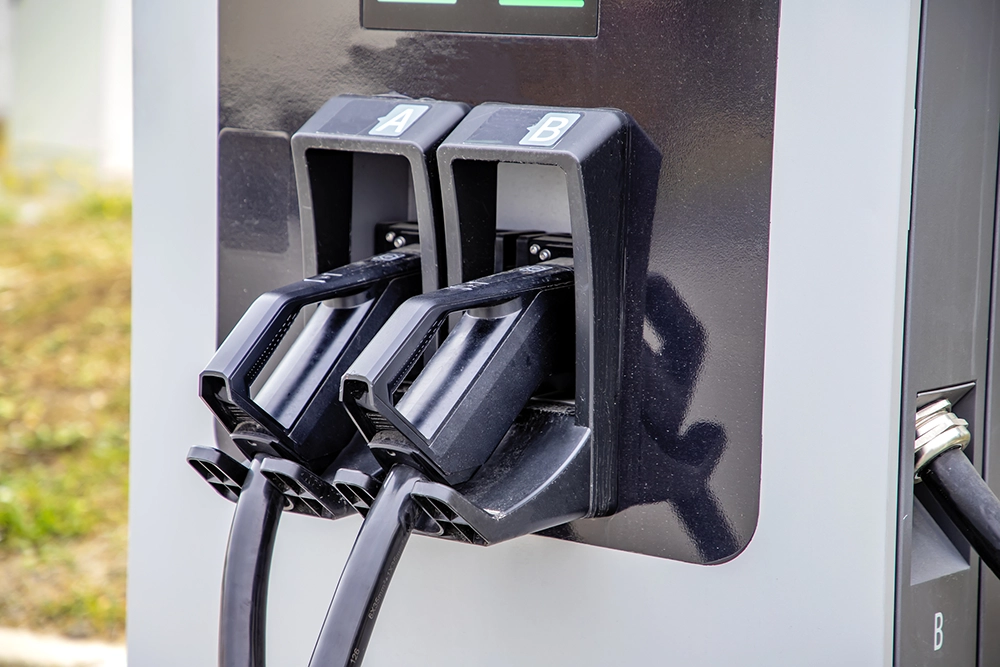
Most projects are Level 2 deployments, which suit long dwell times at homes, workplaces and hotels. Where the site, service capacity and use case genuinely justify it, we also take on qualified DC fast-charging projects. When budget or capacity is the constraint, staged expansion is often the smarter path — install the first phase properly, add the rest on your schedule.
We coordinate permitting and inspection for the installation work. We are an installation contractor: we do not provide charging network software, payment processing, manufacturer authorization or utility incentive programs.
Installing an EV charger is not just mounting hardware on a wall. It adds one of the largest continuous electrical loads a property will ever have.
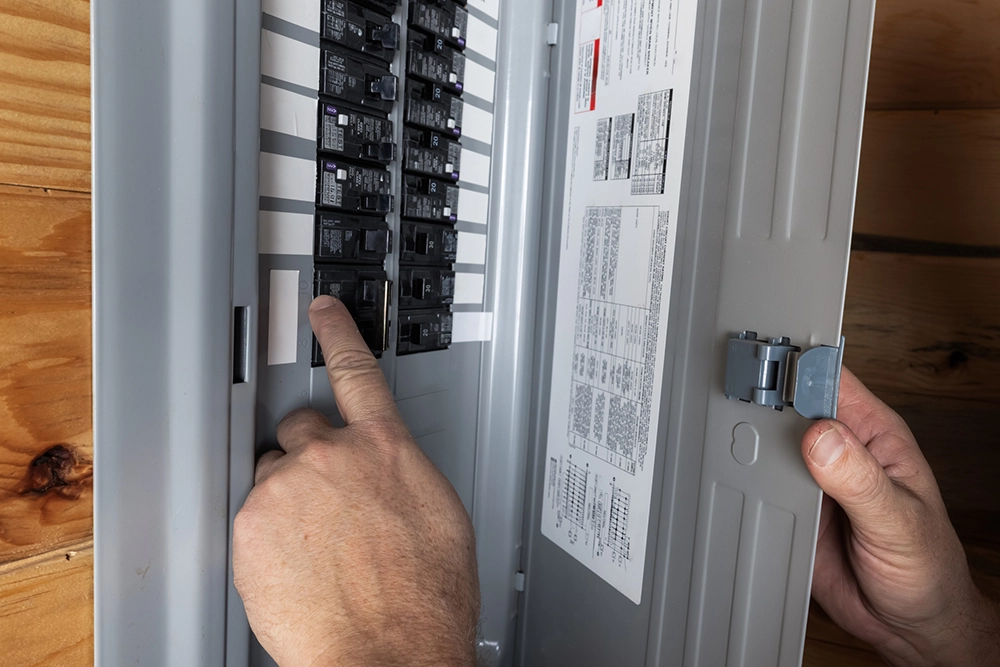
Before we recommend anything, we review your electrical service and run a load calculation. That tells us what your system supports with the appliances you already have, rather than guessing from the size of the panel or the number of empty slots.
From there we plan the breaker and circuit: what size, where it lands in the panel, and how the wire routes to your parking spot. If capacity is short, a panel upgrade is one answer — but it is not the only one, and it is rarely the first one we reach for.
Often a charger configured to a slightly lower current still fills the car overnight. Load management can share capacity with large appliances so the charger backs off instead of overloading the service. And where the utility service itself is the limit, we coordinate a service upgrade as applicable.
When the load calculation and the project genuinely require more capacity, we handle or coordinate the panel upgrade — including permitting and utility coordination as applicable. Planning range is typically $3,000–$5,000 on top of the charger installation.
That figure is a typical planning range, not a quote. And it is worth repeating: many homes do not need a panel upgrade at all. We will show you the numbers either way, so the decision is yours and not a surprise.
Equipment
Charger Supply and Installation
Two ways this goes, and both are completely normal.
You already own a charger
Send us the make and model. If it is a major compatible charger, we install it — and we will tell you what circuit it needs, whether it should be hardwired, and what current your panel can actually give it.
If the unit you bought is not a good match for your vehicle or your electrical service, we will say so before installation rather than after.
You want help choosing
We can supply suitable equipment as part of the project. For quality and value we often lean toward the Tesla Wall Connector and ChargePoint, but other major compatible brands can be installed just as well.
We are an independent installer and do not claim manufacturer certification or authorization. Our recommendation is based on your vehicle, your panel and your parking spot.
EV charger work is electrical work. Where a local electrical permit and inspection apply, we pull and coordinate them so you are not the one calling the building department or scheduling an inspector around your workday.
You get documentation of what was installed, and if an inspection turns up an issue caused by our installation work, we correct it at no charge under our workmanship policy. Doing it on the record protects your home, your insurance and your resale value.
Charger Maintenance and Repair
If your charging setup has started behaving oddly, we can look at it. Common calls are charging that stops partway, a breaker that keeps tripping, a charger that will not wake up, visible damage at the connection, or an older installation you would like inspected before you trust it.
We diagnose the electrical side — circuit, breaker, connections and installation — and can replace or relocate the charger where that is the answer. Whether a faulty charger itself is covered is determined by the manufacturer's warranty, not by us, but we will help you identify the fault so that conversation is short.
Removal and Relocation
Moving house, renovating the garage, changing where you park, or upgrading to a newer charger? We relocate existing chargers, swap equipment, and remove old units cleanly, leaving the electrical work in a safe finished state.
One thing to expect: a new location is a new installation electrically. The route for the wiring and the available capacity both have to be reviewed again, so a relocation is not automatically cheaper than the original install.
New Construction and Builders
The cheapest time to prepare for EV charging is before the walls close and before the driveway or parking area is poured. We work with homeowners, builders and developers to plan conduit runs, panel capacity and charger locations during construction.
Preplanning avoids cutting into finished surfaces later, makes a second charger or additional stations straightforward, and keeps the electrical service correctly sized from day one instead of needing an upgrade a year in.
How it works
Five steps, and only the first two need anything from you
1
Tell us about your EV and property
What you drive, where you park, and what you want charging to feel like day to day.
2
Send a few simple photos
Your electrical panel, your parking spot, and roughly how far apart they are. That is the homework.
3
We work out the technical part
Available capacity, circuit size, wiring route, the right charger, and the full scope of work.
4
You get a clear estimate and plan
Transparent pricing, what is included, and what to expect — reviewed with you before anything starts.
5
We install and document it
Installation, completed-work photos, and permitting and inspection coordination as applicable.
Transparent pricing
Planning ranges for EV charging projects
These are typical ranges to help you budget. They are not quotes — your written estimate comes after we look at your specific property.
What moves the number: the distance and route from the panel to the parking spot, any trenching or conduit, how much panel capacity you already have, which charger hardware you choose, permits, whether a service upgrade is needed, overall site complexity, and how many chargers you are installing. See what drives installation cost.
Installed right. The first time.
What stands behind every service
Whatever the scope — a single home charger or a staged commercial deployment — this is what you can expect after the work is finished.
2-year workmanship warranty on our installation work.
Manufacturer equipment warranty passes through to you.
We aim to respond to workmanship concerns within 1 business day.
No-charge correction of defects caused by our installation work.
Free correction of inspection issues caused by our installation work.
Photos and documentation of the completed work.
Where we work
Serving the Charleston region
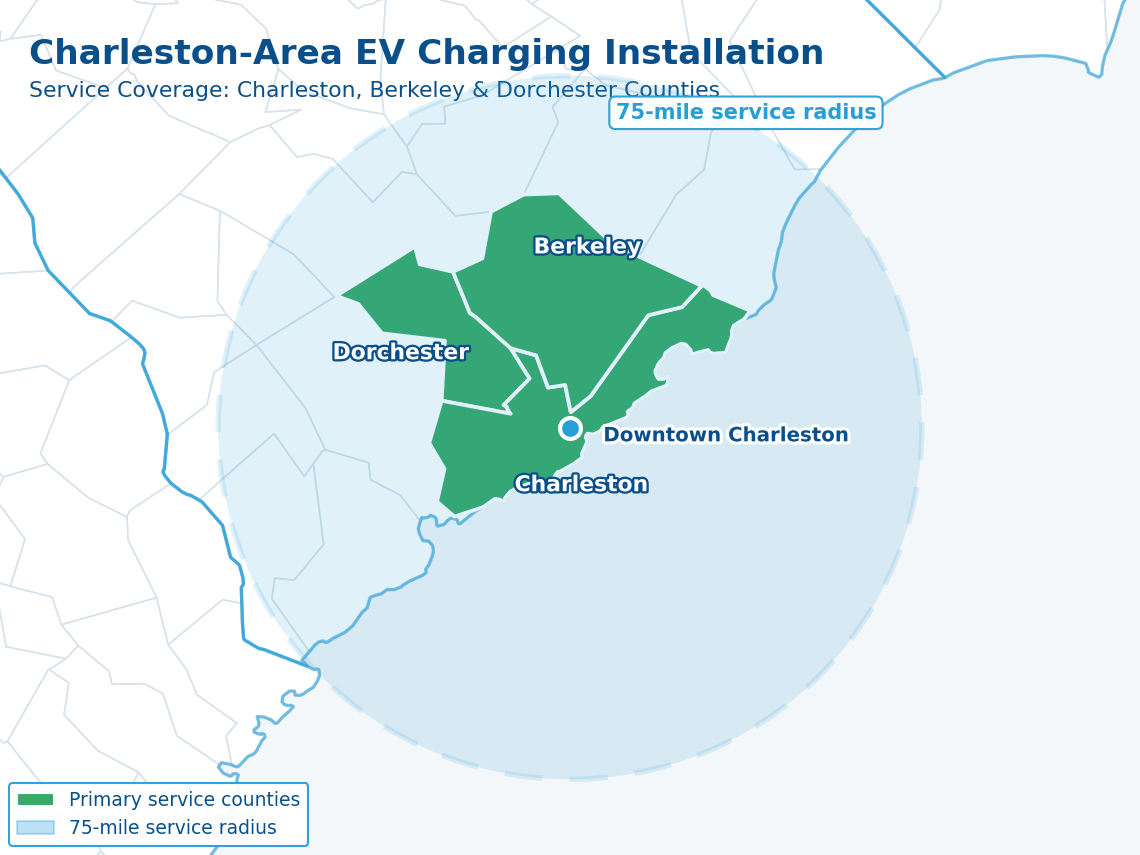
Every service on this page is available across our primary service area: Charleston County, Berkeley County and Dorchester County.
That includes Charleston, Mount Pleasant, North Charleston, Summerville, Goose Creek, Moncks Corner, James Island, Johns Island and the surrounding communities. Projects outside these three counties are evaluated individually — call and we will tell you honestly whether we are a good fit.
Short answers first. Open Read More when you want the full detail.
What EV charger installation services do you offer?
We install residential and commercial EV chargers, plus the electrical work behind them: load assessments, circuits, panel upgrades, load management, repairs, relocation and expansion planning.
Can you install a charger I already purchased?
Yes. Send us the make and model and we will install it, as long as it is a major compatible charger suited to your vehicle and electrical service.
Do you install Tesla Wall Connectors?
Yes. The Tesla Wall Connector is one of the units we install most often, and it is a strong option for many non-Tesla vehicles too.
Do you install other EV charger brands?
Yes. We install all major compatible EV chargers. We often suggest Tesla or ChargePoint for quality and value, but you are not limited to them.
Can you tell me if my panel can support an EV charger?
Yes — that is a standard part of every estimate. We review your electrical service and run a load calculation instead of guessing from the panel size.
Do you perform panel upgrades if needed?
Yes, we handle or coordinate panel upgrades when the load calculation requires one — typically $3,000–$5,000 as a planning range, not a quote.
Do you handle permits and inspections?
Yes. Where a local electrical permit and inspection apply, we pull and coordinate them as part of the project so you are not chasing the building department.
Can you install EV chargers outdoors or in detached garages?
Yes, both are common here. Outdoor installations use weather-rated equipment, and detached garages need a properly protected route for the wiring.
Do you install commercial and fleet EV charging systems?
Yes. We install Level 2 charging for multifamily, workplace, retail, hospitality and fleet sites, plus qualified DC fast-charging projects where the site supports them.
Do you repair, replace, or relocate existing EV chargers?
Yes. We diagnose charging interruptions and circuit issues, replace or relocate equipment, and inspect existing installations.
Not Sure Which Service You Need? That's Normal.
You do not have to diagnose your own project. Tell us what you drive, where you park, and what you want charging to feel like — we will work out the technical path and put it in writing.