
Home Electrical Capacity
Can My Electrical Panel Handle an EV Charger?
Many homes can support Level 2 charging without any panel upgrade at all. The answer comes from evaluating what your home's electrical system is actually carrying today — not from looking for an empty breaker slot.
You do not need to work any of this out yourself. Send us a few photos and we will tell you what your home can support and what we recommend.
Direct answer
Do I Need a Panel Upgrade for an EV Charger?
Often, no. Many homes can support Level 2 charging as they are. The right answer comes from a load calculation and the charging level you actually need — not from assuming every EV charger requires a 48A circuit.
A great deal of worry on this subject comes from a single assumption: that home charging means the fastest possible circuit. In practice, the useful question is what charging speed makes your mornings easy, and whether your home can support that. Those two answers together usually point to a straightforward installation.
Short answer
Most homes do not need a panel upgrade to charge an EV well.
A load calculation tells us how much additional continuous charging load your electrical system can support. From there we recommend the simplest safe option — which is usually a correctly sized Level 2 circuit on the panel you already have.
Plain English
What Is an EV Charger Load Calculation?
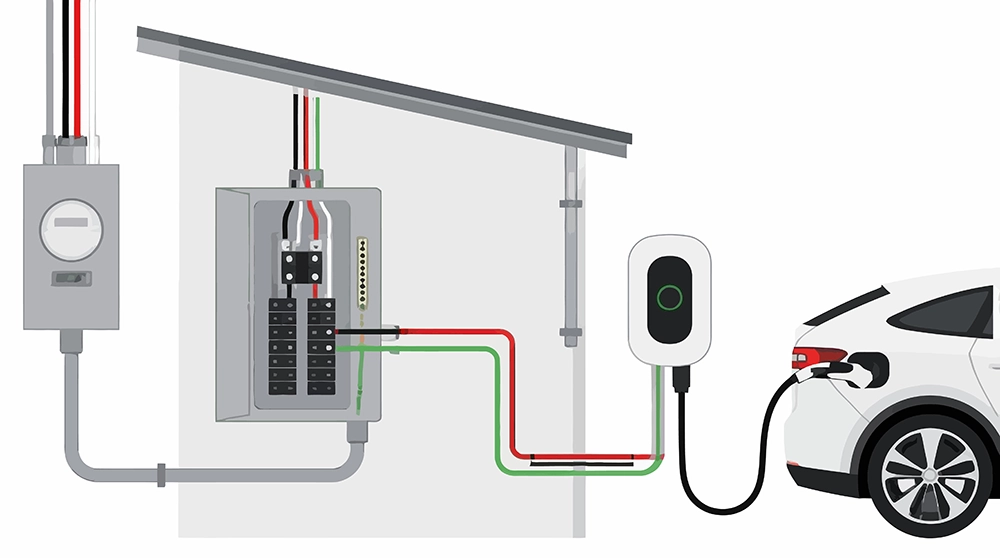
It is the method a qualified electrical professional uses to evaluate what your home's electrical system is already carrying and how much more it can safely support.
- It looks at the home's electrical service and its major existing loads — things like heating and cooling, a range, a water heater, a dryer.
- It helps determine how much additional continuous EV charging load the system can support.
- It is not the homeowner's job to calculate. Please do not try to work this out from a breaker list.
- We use the result to recommend the charger current and circuit that fit both your home and your vehicle.
EV charging is different from most household loads because it draws steadily for hours, rather than in short bursts. That is exactly why it is evaluated properly instead of estimated.
Common misunderstanding
Why Empty Breaker Spaces Don't Tell the Whole Story
Physical room for a breaker and available electrical capacity are two different things. This is the single most common misunderstanding we hear.
Space in the panel is physical room
An empty slot means a breaker can be mounted there. It says nothing about how much of the home's electrical capacity is already committed to other equipment.
A panel with empty spaces can still be tight
The service supplying the panel may already be close to fully allocated by existing loads. Room for another breaker does not create additional capacity.
A panel that looks full may still work
Panels that appear to have no room sometimes still have capacity, and there are legitimate design options for accommodating a new circuit.
The assessment decides, not the appearance
Our recommendation comes from the load assessment and your vehicle's charging capability — never from how crowded the panel looks in a photo.
Planning points
Common Level 2 Circuit Sizes
These are common planning points that come up in conversation — not universal recommendations. Not every home or vehicle supports the largest of them.
| 32A charger output | 40A charger output | 48A charger output | |
|---|---|---|---|
| Approximate power | About 7.7 kW | About 9.6 kW | About 11.5 kW |
| Typically discussed when | Capacity is moderate, or the vehicle cannot use more anyway | There is comfortable capacity and the vehicle can use it | There is ample capacity and the vehicle supports higher AC charging |
| Home capacity required | Lowest of the three | Higher | Highest — not available in every home |
| Real-world result | Still several times the power of a standard 120V outlet | Faster overnight recovery where the vehicle can use it | Only faster if the vehicle's onboard charger can accept it |
32A charger output
- Approximate power
- About 7.7 kW
- Typically discussed when
- Capacity is moderate, or the vehicle cannot use more anyway
- Home capacity required
- Lowest of the three
- Real-world result
- Still several times the power of a standard 120V outlet
40A charger output
- Approximate power
- About 9.6 kW
- Typically discussed when
- There is comfortable capacity and the vehicle can use it
- Home capacity required
- Higher
- Real-world result
- Faster overnight recovery where the vehicle can use it
48A charger output
- Approximate power
- About 11.5 kW
- Typically discussed when
- There is ample capacity and the vehicle supports higher AC charging
- Home capacity required
- Highest — not available in every home
- Real-world result
- Only faster if the vehicle's onboard charger can accept it
A bigger circuit does not automatically mean faster charging. If your vehicle's onboard AC charger accepts less than the circuit can deliver, the vehicle sets the limit. Compare Level 1 and Level 2 charging or see EV charging by vehicle.
If capacity is tight
What If My Panel Doesn't Have Enough Capacity?
Then we work through the simpler options first. An upgrade is what we reach for when nothing else solves the problem — not the opening move.
In that order, most homes find a workable answer well before step five.
1. A lower-current Level 2 circuit
Instead of assuming the largest possible circuit, we size the circuit to what your home can support and what your vehicle can actually use. A smaller Level 2 circuit is still a large step up from a standard 120V outlet, and for many drivers it covers overnight charging comfortably.
2. Load management or energy management equipment
Where it is appropriate, load management equipment lets the charger work within the capacity the home already has by reducing or pausing charging when other large loads are running. In some homes this removes the need for an upgrade entirely.
3. Scheduling or demand control
Many chargers and vehicles can be set to charge during hours when the rest of the house is drawing less. Where the equipment supports it, scheduling can be part of a sensible plan rather than an afterthought.
4. Power sharing for two EVs
If two vehicles need charging, compatible equipment can divide the available power between two chargers instead of requiring double the capacity. This depends on the specific equipment being used.
5. A panel or service upgrade, only if needed
An upgrade is the last option, not the first. We recommend one when the load calculation shows there is no reasonable capacity for a useful charging level, or when the electrical equipment itself needs to be replaced as part of the work.
Lower current, still Level 2
Is 32A Level 2 Charging Enough?
For many drivers, yes. Around 7.7 kW is still several times the power of standard 120V charging, and it can comfortably support overnight charging for many EV owners.
The thing most people want from home charging is simple: plug in when you get home, and have what you need in the morning. A well-sized lower-current Level 2 circuit achieves that for a lot of households — and it may fit your existing panel without any upgrade.
We would rather install a circuit that suits your home and your vehicle than sell you capacity you will never use.
What matters more than the number
- How many miles you actually drive on a normal day
- How many hours the car sits parked at home overnight
- What your vehicle's onboard AC charger can accept
- What your home's electrical system can support safely
Last resort, not first step
When Is a Panel Upgrade Actually Necessary?
Sometimes it genuinely is the right answer. These are the situations where it tends to come up:
The load calculation leaves no reasonable capacity
If there is no room for a charging level that would actually be useful to you, even after considering lower-current options and load management, an upgrade becomes the honest recommendation.
Equipment needs replacement as part of the work
Where existing equipment is obsolete, damaged or otherwise needs to be replaced to complete the electrical work correctly, that becomes part of the project. Age on its own does not require an upgrade.
The service size is inadequate for the wider plan
Sometimes the EV charger is not really the issue — the home's service is already undersized for what is installed and planned. In that case the upgrade solves more than charging.
Broader electrification is planned
If a heat pump, induction range, water heater or a second EV is coming, some homeowners choose a larger upgrade once rather than revisiting the panel repeatedly.
Typical planning range: $3,000–$5,000 when a panel upgrade is genuinely required. That is a planning range to help you budget, not a guaranteed quote. Work involving the incoming service can add complexity and coordination, and it is very site-specific — requirements vary by jurisdiction and utility.
Service size
Can a 100-Amp Panel Support an EV Charger?
Sometimes, yes. Service rating alone does not determine the answer.
A 100A home with modest existing loads may well support a useful Level 2 circuit. A heavily loaded 200A home may have less available capacity than the homeowner expects. The number stamped on the main breaker describes the size of the service, not how much of it is already committed.
This is why we do not answer this question over the phone from the service rating alone. The load calculation decides — and it frequently produces good news for homes people assumed were too small.
Short answer
A 100A service can sometimes support Level 2 charging. A 200A service does not guarantee it.
What matters is the gap between what the service can deliver and what the home already uses. That gap is what the load calculation measures.
Future planning
What If We're Planning for Two EVs?
Two EVs do not automatically mean twice the electrical capacity. There are several ways to handle it, and it is much easier to plan for now than to retrofit later.
One charger, two vehicles
Depending on driving patterns and schedules, a single charger can often serve two cars — many households simply alternate nights.
Two chargers, if capacity allows
Where the load calculation supports it, two separate circuits and chargers can be installed so both cars charge independently.
Power sharing
Compatible equipment can divide the available power between two chargers, so both cars can be plugged in without exceeding what the home supports.
Plan the pathway now
If a second EV is likely, we can plan conduit, capacity and charger placement during the first installation so the second one is straightforward.
More detail on home setups is on our residential EV charger installation page, and vehicle-specific notes are on EV charging by vehicle. For equipment that supports power sharing, see EV charger brands.
Our side of the work
What We Look At Before Recommending a Charger Circuit
This is our list, not yours. You provide basic information and a few photos — we handle everything below.
You will never be asked to interpret a load calculation, identify a breaker or judge your own service capacity. That is the whole point of calling a specialist.
- The service rating and the general condition of the panel and equipment
- The existing major electrical loads in the home
- A load calculation to evaluate demand and available capacity
- The panel configuration and how a new circuit would be accommodated
- Your EV make and model, and its onboard AC charging capability
- The charging speed you actually want day to day
- The distance and routing between the panel and the charger location
- Whether a second EV or other electrification is likely later
- Whether the equipment is hardwired or plug-in, and what it requires
- Outdoor, carport or detached garage considerations
Your side of the work
What Should I Send for an EV Charger Estimate?
Six simple things, all of which you can capture on a phone in a couple of minutes.
- A photo of the breaker panel with the cover open — no screws removed
- A photo of the service location label, usually on the inside door panel
- A photo of where you would like the charger installed
- A photo showing the rough route and distance between the panel and where you park
- The charger model or label, if you already have one
- Your EV make and model
Photo tip: open the cover, keep the screws in
Do not remove any screws. Open the panel cover and take pictures of the breaker panel and the service location label, usually on the inside door panel. That tells us the service rating, the breakers in use and the general condition of the equipment.
If we need to see more, a licensed electrical professional does that safely during a site visit. Do not remove any screws and do not test anything.
How it works
From Photos to a Clear Recommendation
Four steps. You handle the first one; we handle the rest.
- 1
Send your EV and property details
Your vehicle, where you park, and a few photos. That is all we need to start — no measurements, no calculations.
- 2
We review the panel and the load
We evaluate the service, the existing loads and the charging level you want using a load calculation.
- 3
You get a recommendation
The circuit and charger current that fit your home and vehicle, load management where it helps, or an upgrade only if it is genuinely required.
- 4
Written estimate, then installation
A clear written price first. Then installation, testing, and permitting and inspection coordination where applicable.
Transparent pricing
What This Usually Costs
Typical planning ranges to help you budget. Neither is a guaranteed quote — the panel decision is made before we quote the final scope.
Residential Level 2 installation
Covers most straightforward home Level 2 installations in the Charleston area.
$1,000–$2,000typical planning range
- Load calculation and panel assessment
- Dedicated 240V circuit sized for your home and vehicle
- Charger mounted, connected, configured and tested
- Permitting and inspection coordination as applicable
Electrical panel upgrade
Many homes never need this. We look at lower-current circuits and load management first.
$3,000–$5,000typical planning range, only if genuinely required
- Recommended only when the load calculation calls for it
- Alternatives reviewed and explained before we suggest it
- Priced as its own clearly separated part of the scope
We settle the panel question before quoting the final scope, so your written estimate reflects what your home actually needs rather than a guess with a disclaimer attached.
Where we work
Panel Assessments Across the Tri-County
We evaluate panels and install EV charging throughout Charleston, Berkeley and Dorchester counties. Panel age, service configuration and permitting jurisdiction all vary considerably across the region, so every property is evaluated individually.
Charleston County
Berkeley County
Dorchester County
FAQ
Electrical Panel and EV Charger Questions
Useful short answers up front, with the full explanation one click behind each one.
- Do I need a panel upgrade to install an EV charger?
- Often no. Many homes support Level 2 charging as they are. A load calculation and the charging level you actually need decide the answer.
- Can a 100-amp panel support a Level 2 charger?
- Sometimes, yes. Service rating alone does not determine the answer — the load calculation does.
- Does an empty breaker space mean I have enough capacity?
- No. An empty space is physical room for a breaker. It says nothing about how much of the home's electrical capacity is already committed.
- What is an electrical load calculation for an EV charger?
- It is how a qualified professional evaluates the home's existing electrical demand and works out how much additional continuous charging load the system can support.
- Is a 32A charger enough for home charging?
- For many drivers, yes. About 7.7 kW is still several times the power of standard 120V charging and supports overnight charging comfortably for many EV owners.
- Can load management prevent a panel upgrade?
- Sometimes, yes. Where it is appropriate, load management equipment lets the charger work within the capacity the home already has.
- Can I install two EV chargers on one electrical service?
- Often yes, depending on capacity. Two separate circuits may be possible, or compatible equipment can share the available power between chargers.
- How much does an electrical panel upgrade cost?
- When one is genuinely required, a typical planning range is $3,000–$5,000. That is a budgeting range, not a guaranteed quote.
- Can you tell from a photo whether my panel can handle an EV charger?
- Photos give us useful preliminary information, but final capacity depends on the load assessment and sometimes on additional information or a site visit.
- How do I photograph my electrical panel for an estimate?
- Do not remove any screws. Open the panel cover and take pictures of the breaker panel and the service location label, usually on the inside door panel.
Find Out What Your Home Can Support.
You do not need to understand load calculations, amperage or panel sizing. Send us your vehicle details and a few photos, and we will tell you what your home can support and recommend the simplest safe option.
Or call (843) 508-9061 — Monday–Friday, 9:00 AM–5:00 PM
Related pages
Keep reading
Prefer to talk it through? Call (843) 508-9061 — Monday–Friday, 9:00 AM–5:00 PM.