Commercial EV Charger Installation in Charleston, SC
More Miles EV plans and installs EV charging for multifamily, workplace, retail, hospitality and fleet properties — from site assessment and electrical capacity planning through installation, permitting and inspection coordination.
What Does a Commercial EV Charging Project Include?
A commercial project is a site assessment, an electrical capacity plan and an installation. We review the property and its parking, look at how long vehicles stay, assess the electrical service and run a load calculation, recommend Level 2 or DC fast charging based on how the site is used, set the charger quantity and placement, plan the conduit, trenching and wiring route, build in a staged expansion path, coordinate permitting and inspection, then install, test and document the work.
Our scope is the physical infrastructure and the electrical work behind it. Charging network software, session pricing and payment platforms are set up separately with your chosen provider — we install equipment that works with the platform you select and coordinate with whoever configures it.
Property and site assessment
We walk the property, look at the parking areas and note what the site can realistically support today.
Parking and dwell time
In plain terms: where do vehicles park, and how long do they sit there? That drives almost every other decision.
Electrical service and capacity review
We review the service feeding the property and what is already committed to it, rather than assuming headroom exists.
Load calculation
A calculation shows how much capacity is genuinely available for charging and how many stations that supports.
Level 2 vs. DC fast recommendation
We recommend the charging type that fits how vehicles actually use your property, not the biggest option available.
Charger quantity and placement
How many stations to start with, and which spaces make them convenient without disrupting circulation.
Conduit, trenching and wiring route
The path from the electrical source to the parking area, planned before pavement or walls are opened.
Staged expansion planning
Infrastructure sized for where the property is heading, so adding stations later is a small job instead of a new project.
Permitting and inspection coordination
We pull and coordinate the permits and inspections that apply to the electrical scope of the project.
Installation, testing and documentation
Stations installed and configured, charging verified, and the completed work documented with photos.
By property type
Charging Strategy Depends on How Your Property Is Used
The same equipment suits very different properties in very different ways. These are common patterns, not universal rules — your site gets its own assessment.
Multifamily, apartments and condos
Residents want reliable overnight charging at home, and prospective tenants increasingly ask about it before signing.
Typical dwell time
Vehicles are usually parked overnight — often ten hours or more.
What often makes sense
Level 2 typically fits well. Long dwell times mean a modest number of stations can serve many residents, especially where assigned versus shared parking is thought through early and conduit is set for later phases.
Workplace and office
Employees top up during the workday, which supports commuting distances that a home outlet alone may not cover.
Typical dwell time
Typically a full shift — commonly six to nine hours.
What often makes sense
Level 2 usually makes sense, and power sharing or load management can serve more spaces from the same capacity where the equipment supports it. Many workplaces start with a few stations and expand as employee EV ownership grows.
Hotels and hospitality
Charging is an amenity guests filter for when booking, and it keeps guests on the property rather than searching elsewhere.
Typical dwell time
Overnight for guests; shorter for events, dining or valet turnover.
What often makes sense
Level 2 covers overnight stays comfortably. Properties with event traffic or short-stay patterns sometimes benefit from a faster option in a limited number of spaces, which is a bigger infrastructure conversation.
Retail and mixed-use
Charging gives customers a reason to choose your center and a reason to stay longer while the car charges.
Typical dwell time
Highly variable — twenty minutes at one tenant, a few hours at another.
What often makes sense
The right answer depends on your tenant mix. Longer-dwell centers with dining, fitness or cinema tenants often suit Level 2, while high-turnover sites are where DC fast charging is worth evaluating — along with the larger electrical work it involves.
Fleet and service yards
Vehicles have to be ready for their next route, so charging becomes an operational requirement rather than an amenity.
Typical dwell time
Usually predictable — parked between shifts or overnight at the yard.
What often makes sense
Predictable schedules are an advantage: Level 2 with sequenced or managed charging often covers overnight fleets efficiently. Fast turnaround operations may need higher-power equipment and correspondingly more electrical infrastructure.
Level 2 vs. DC fast charging
Which Type of Charging Fits a Commercial Site?
The short version: if vehicles sit for hours, Level 2 usually fits. If they only stop briefly and you need throughput, DC fast charging enters the conversation — along with substantially more electrical infrastructure and coordination.
A qualitative comparison for commercial decision-making. Every site still needs its own assessment.
Level 2 charging
DC fast charging
Typical dwell time
Suits vehicles parked for hours — a shift, a visit or overnight
Suits short stops where drivers want to leave quickly
Relative power demand
Moderate per station, and manageable on many existing services
Substantially higher, and often the deciding constraint on a site
Infrastructure complexity
Lower — often distribution work, conduit and circuits
Higher — may involve major distribution work and utility coordination
Vehicles served over time
Many, because long dwell times let a station serve driver after driver
High throughput per station when turnover is genuinely fast
Expansion is a larger project — capacity has to be planned deliberately up front
Most commercial properties in the tri-county area are well served by Level 2. We will tell you plainly if your use case points toward faster equipment, and what that would mean for the electrical work. Our Level 1 vs. Level 2 guide explains the basics, though it is written for homeowners — the business-use distinction is the one described on this page.
Site assessment
What We Look at Before Recommending Chargers
Recommending equipment before understanding the site is how commercial projects end up rebuilt. This is the work that happens first.
Where vehicles actually park
Not the spaces on a drawing — the spaces people really use, and who has rights to them.
Expected EV users now and later
How many drivers need charging today, and a realistic view of the growth you are planning around.
How long vehicles dwell
The single biggest factor in choosing between Level 2 and faster equipment.
Distance from electrical service to parking
Long runs mean more conduit, more trenching and more restoration — so we measure early.
Available service and panel capacity
What the property's electrical service can support once existing loads are properly accounted for.
Existing distribution equipment on site
Where a subpanel or other distribution equipment already sits near the parking area, we review whether it can help. We confirm what is there rather than assume.
Trenching and conduit requirements
Whether the route crosses pavement, landscaping or walkways, and what restoration that implies.
Weather exposure and physical protection
Outdoor-rated equipment, mounting choices, and bollards or wheel stops where vehicle contact is a real risk.
Accessibility and space layout
Accessible-space and access considerations are part of the layout discussion. We plan around them and defer to your jurisdiction and design professionals on requirements — we do not provide legal advice.
Permitting jurisdiction
Which authority reviews the work, since requirements and timelines differ across the tri-county area.
Room for future expansion
What it would take to add the next set of stations, and what we can do now to make that cheap.
Why the order matters
Equipment is the easy part. Capacity, distance and the conduit route are what determine cost, schedule and how easily you can add stations later.
Plan wide, install as needed
Build Capacity for More Stations Than You Install Today
Commercial charging tends to work best when the underground and electrical groundwork is planned for more stations than the property needs on day one. The chargers themselves are the least disruptive part of the project. Conduit under pavement, a subpanel near the parking area and reserved capacity are the expensive parts to add afterwards.
So we plan the route and the distribution for where the property is heading, then install the stations you want now. When demand grows, adding the next stations is typically pulling wire through conduit that already exists instead of reopening pavement, walkways or finished walls.
Where capacity is tight, load management and power sharing can let more spaces draw from the same service, provided the equipment supports it. We confirm what your selected hardware can actually do before we build a plan around it.
Distance from the electrical source to the parking area
Trenching, conduit and pathway requirements
Available panel and service capacity
The charger hardware selected
Permitting requirements in your jurisdiction
Whether a service upgrade is needed
Overall site complexity and access
Bollards or physical protection where needed
Whether the work is staged across phases
We do not publish per-port or DC fast charging pricing, because those figures depend entirely on the site and the equipment. You get real numbers after the evaluation. See what drives installation cost.
Either path is normal on a commercial project, and neither changes how carefully the electrical side is planned.
We install major compatible commercial charging equipment. If your ownership group, franchise standard or management company has already selected hardware, we install what you have specified and confirm the circuits and capacity it needs.
If the choice is open, we can supply equipment as part of the project. For quality and value we often lean toward Tesla and ChargePoint, and other major compatible brands install just as well. We are an independent installer and do not claim manufacturer certification, authorization or partner status.
Where a project involves a charging network, session pricing or payment handling, that is configured with your chosen platform provider. We plan the installation so the equipment you select works the way you intend.
What We Handle, and What May Involve Other Providers
Commercial projects touch several trades and agencies. Setting that out clearly at the start keeps the schedule honest.
What More Miles EV handles
EV charging station installation
Dedicated circuits and the electrical distribution for the project
Capacity planning and load assessment
Panel and distribution work where the project requires it
Conduit and trenching electrical scope as applicable
Permitting and inspection coordination
Testing, configuration and completed-work documentation
What may involve other providers
Depending on the project, these items sit with other parties. We coordinate with them as part of running the job — they are simply not ours to perform.
Utility service upgrades and utility scheduling
Civil and parking-lot restoration beyond the normal electrical scope
Charging network, software and payment platform setup
Grant, rebate and incentive program administration
Stamped engineering plans where the jurisdiction or project requires them
Installed right. The first time.
What Stands Behind the Installation
Charging becomes part of your property's electrical infrastructure. Here is what you can expect once the work is complete.
2-year workmanship warranty on our installation work.
Manufacturer equipment warranty passes through to the property.
We aim to respond to workmanship concerns within 1 business day.
No-charge correction of defects caused by our installation work.
Free correction of inspection issues caused by our installation work.
Photos and documentation of the completed work for your records.
Where we work
Commercial Projects Across the Tri-County Area
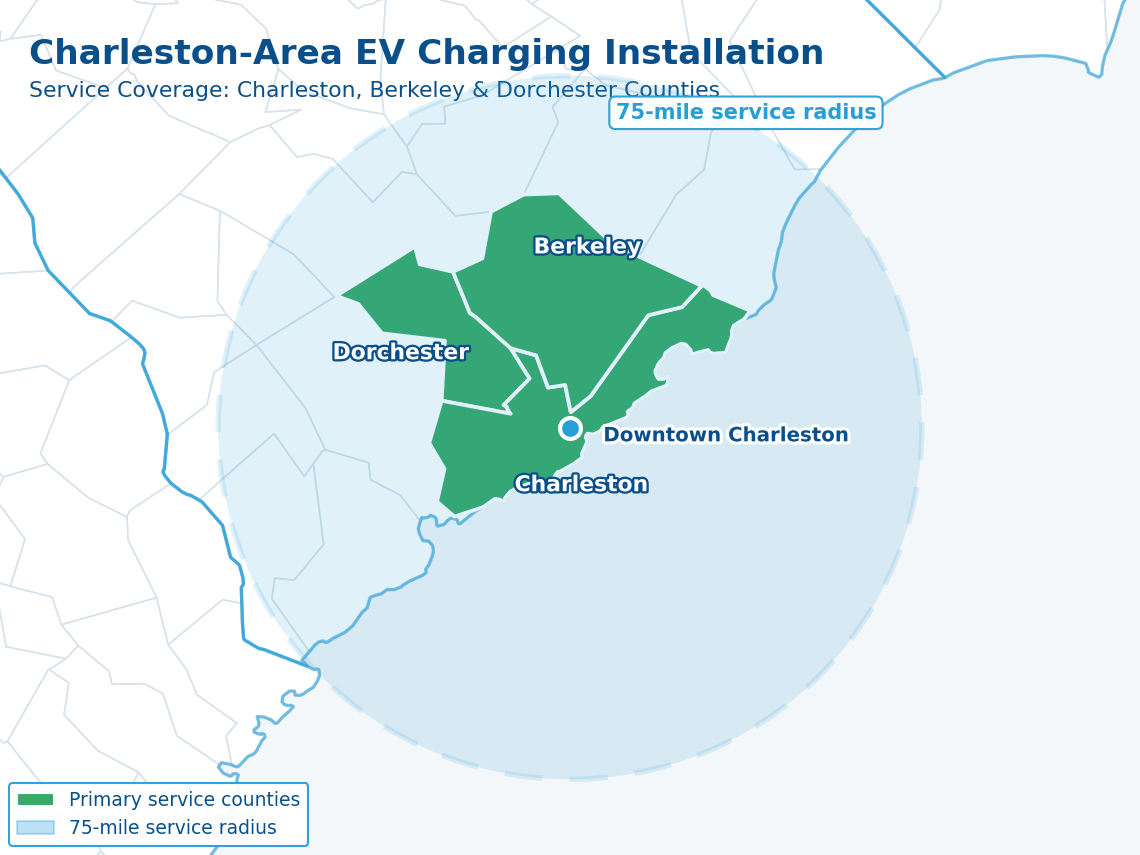
We take on commercial EV charging projects throughout Charleston County, Berkeley County and Dorchester County — including Charleston, Mount Pleasant, North Charleston, Summerville, Goose Creek and Moncks Corner.
Projects outside these three counties are evaluated individually. Call us and we will tell you honestly whether we are the right fit.
Commercial EV charging questions, answered directly
Short answers first. Open Read More for the fuller explanation.
What types of commercial properties do you install EV chargers for?
Multifamily communities, workplaces and offices, hotels, retail and mixed-use centers, and fleet or service yards across the tri-county area.
Should a commercial property use Level 2 or DC fast charging?
It depends on how long vehicles stay. Level 2 suits properties where cars sit for hours; DC fast charging suits short stops and high turnover, and needs far more electrical infrastructure.
How many EV chargers should we install to start?
Usually fewer than people expect, on infrastructure planned for more. Starting modestly and expanding on prepared pathways is normally the better use of budget.
Can we install a few chargers now and add more later?
Yes, and that is often the smartest approach. We plan the conduit and capacity for the full build-out, then install the stations you need today.
How much does a commercial EV charger project cost?
Commercial multi-unit projects typically fall in a planning range of about $5,000–$30,000+. That is a budgeting range, not a quote.
Can our existing electrical service support multiple chargers?
Often yes, more than owners expect. We run a load calculation on the actual service instead of estimating from the panel size or spare breaker spaces.
Do you handle trenching, conduit, permits, and inspections?
We handle the electrical scope including conduit and trenching as applicable, and we coordinate the permits and inspections the project requires.
Can you install chargers in apartment or condo communities?
Yes. Multifamily is one of the best fits for Level 2, because residents park overnight and long dwell times let a few stations serve many drivers.
Can you install chargers for a fleet or workplace?
Yes. Both have predictable parking patterns, which makes them well suited to Level 2 with managed or sequenced charging.
How long does a commercial EV charging project take?
It depends on the project, and we will not quote a fixed timeline before seeing the site. Scale, permitting, trenching and utility involvement are the main variables.
Plan the Infrastructure Once. Add Chargers as Demand Grows.
The stations are the visible part. The electrical foundation underneath is what decides whether your next phase is a quick addition or a second construction project. Get that right at the start, and charging becomes something your property can grow into.