Tesla Home Charging
Tesla Wall Connector Installation in Charleston, SC
More Miles EV installs Tesla Wall Connectors for homeowners across Charleston, Berkeley and Dorchester counties — including electrical assessment, circuit sizing, mounting, setup, testing, and permitting and inspection coordination where applicable.
You do not need to work out amperage, panel capacity or charger settings. Tell us what you drive and where you park, and we will handle the technical side.
More Miles EV is an independent EV charging installer. We are not certified, authorized, endorsed by or affiliated with Tesla or any other manufacturer, and no affiliation is implied. Product names are used only to describe the equipment we install.
EV charging specialists
Not a general contractor
Licensed electrical professionals
Code-compliant work
2-year workmanship warranty
On our installation work
Transparent pricing
Written estimate before we start
Permitting and inspection support
Coordinated where applicable
Direct answer
Can More Miles EV Install My Tesla Wall Connector?
Yes. You can already own the Wall Connector, or you can ask us to help select and source compatible equipment. We install Tesla Wall Connectors alongside other major compatible chargers, and we stay brand-independent about which one suits you.
Underneath the product name, a Tesla Wall Connector installation is a professionally installed Level 2 home charging setup. The work is about matching a dedicated 240V circuit to two things: what your home's electrical system can genuinely support, and what your vehicle can actually accept on AC charging.
That is the part most homeowners would rather not research. It is also the part we do every week.
Short answer
Yes — whether you bought the charger yourself or want help choosing one.
We assess the panel, size the circuit, install and configure the Wall Connector, test it with your car, and coordinate permitting and inspection where it applies.
Scope of work
What a Tesla Wall Connector Installation Includes
Every project is quoted individually, and requirements such as permitting vary by property and jurisdiction. This is the shape of the work.
Vehicle review
We start with your Tesla model (or other EV) and its AC charging capability, so the installation is sized around the car you actually drive rather than a generic spec.
Panel and load assessment
We evaluate your electrical service, the existing loads in the home and the available capacity using a load calculation.
Circuit and current selection
We determine an appropriate circuit and charger current for your home and vehicle — not automatically the largest option available.
Location and routing
We agree the mounting position and the wiring route, taking into account cable reach, where you park and how you use the space day to day.
Installation and configuration
The Wall Connector is mounted and wired as a fixed home charging unit, then configured for the circuit that was actually installed.
Testing, documentation and warranty
We test charging with your vehicle before we leave, provide completed-work photos and documentation, and back our work with a 2-year workmanship warranty.
Setup, testing and handover
We finish the job properly rather than leaving you with a mounted box and a manual.
- Charger output configured to match the installed circuit
- Charging tested with your vehicle before we finish
- Basic Wi-Fi and app setup guidance where the equipment supports it, following the manufacturer's own instructions
- Permitting and inspection coordination where it applies to your property and jurisdiction
- Completed-work photos and a written record of what was installed
- Plain-English explanation of how to use the charger and what to expect overnight
Sizing, not maximising
Do I Need the Biggest Circuit for a Tesla Wall Connector?
No. A larger circuit does not automatically mean faster charging, and installing the largest available option is not the right goal for most homes.
Two ceilings apply. Your vehicle's onboard AC charger sets the maximum the car can accept, regardless of what the circuit could deliver. And your home's electrical capacity sets what can be installed safely in the first place. The Wall Connector can be configured for the circuit that is actually available, which is a genuine advantage — it adapts to the house.
| 32A charger output | 40A charger output | 48A charger output | |
|---|---|---|---|
| Approximate power | About 7.7 kW | About 9.6 kW | About 11.5 kW |
| Typically discussed when | Capacity is moderate, or the vehicle cannot use more anyway | There is comfortable capacity and the vehicle can use it | There is ample capacity and the vehicle supports higher AC charging |
| Home capacity required | Lowest of the three | Higher | Highest — not available in every home |
| Real-world result | Still several times the power of a standard 120V outlet | Faster overnight recovery where the vehicle can use it | Only faster if the vehicle's onboard charger can accept it |
32A charger output
- Approximate power
- About 7.7 kW
- Typically discussed when
- Capacity is moderate, or the vehicle cannot use more anyway
- Home capacity required
- Lowest of the three
- Real-world result
- Still several times the power of a standard 120V outlet
40A charger output
- Approximate power
- About 9.6 kW
- Typically discussed when
- There is comfortable capacity and the vehicle can use it
- Home capacity required
- Higher
- Real-world result
- Faster overnight recovery where the vehicle can use it
48A charger output
- Approximate power
- About 11.5 kW
- Typically discussed when
- There is ample capacity and the vehicle supports higher AC charging
- Home capacity required
- Highest — not available in every home
- Real-world result
- Only faster if the vehicle's onboard charger can accept it
A lower-current Level 2 circuit is still excellent overnight charging for a great many drivers. See whether your panel can support a charger and how Level 1 and Level 2 compare.
Home electrical capacity
Can My Existing Electrical Panel Support a Tesla Wall Connector?
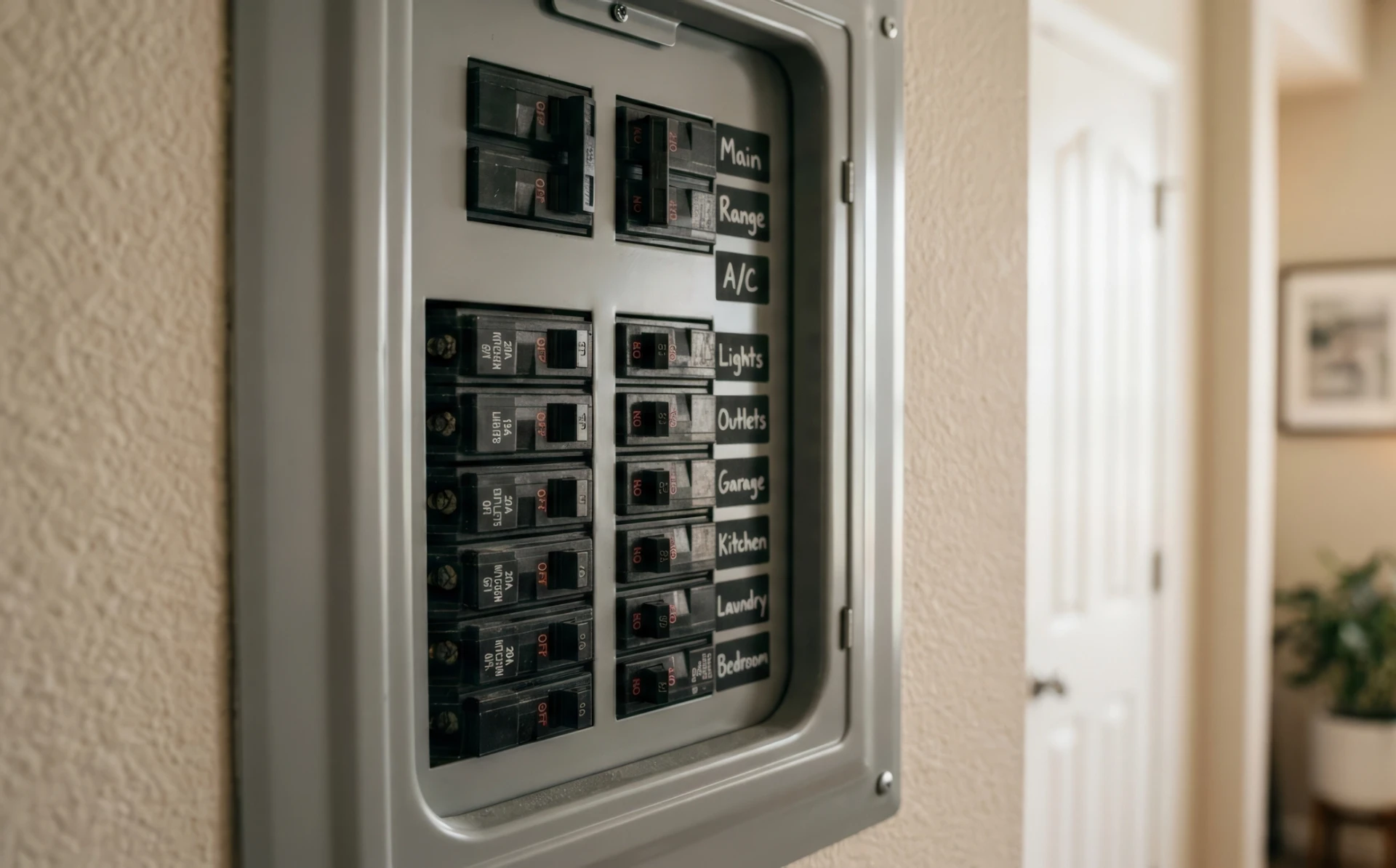
Often, yes — many homes support Level 2 charging exactly as they are, with no panel work at all.
- Empty breaker spaces are not the same thing as available capacity. A space is physical room; capacity is what the electrical service has left after the home's existing loads.
- A load calculation is how the answer is actually determined, and it is our job rather than yours.
- Where capacity is tight, a lower-current circuit or load management equipment can often make charging work without an upgrade.
- A panel or service upgrade is a recommendation of last resort, made only when the calculation genuinely calls for it.
Panel upgrade planning range: $3,000–$5,000, and only where it is genuinely required. That is a planning range to help you budget, not a guaranteed quote.
Placement
Where Can a Tesla Wall Connector Be Installed?
Most parking arrangements can be served. What is possible at a specific spot depends on the site, the wiring route and the requirements that apply locally.
Attached garage
The most common installation. Usually the shortest wiring route and the simplest mounting position, with the charger protected from weather.
Carport
Very workable, with attention to weather exposure, mounting surface and where the cable will sit when it is not in use.
Exterior wall or driveway
Outdoor installations use weather-rated equipment and appropriate protection for the wiring. Placement depends on the wall, the route and the parking position.
Detached garage or outbuilding
Often possible, but it depends on what already feeds the structure. Sometimes existing wiring is sufficient; sometimes additional work is needed.
Longer conduit runs
Distance from the panel affects materials and labour more than anything else. Longer routes are routine, they simply cost more.
Trenching where required
Where a run has to cross open ground, an underground route may be needed. We tell you before quoting if that is likely.
Two practical things people forget
Cable reach. The charge port is not in the same place on every vehicle, and the way you habitually pull into the space matters. A charger mounted in a technically fine location can still be awkward every single day.
Weather exposure. Outdoor and carport installations use weather-rated equipment and appropriate protection for the wiring. We will not simply mount indoor-style work outside because it is closer to the panel.
We confirm placement with you before installation day, so nothing is decided by assumption.
Transparent pricing
How Much Does Tesla Wall Connector Installation Cost?
Typical planning ranges to help you budget. Neither is a guaranteed quote — you get a written price for your specific property before any work begins.
Residential Level 2 installation
Covers most straightforward home Wall Connector installations in the Charleston area.
$1,000–$2,000typical planning range
- Panel and load assessment
- Dedicated 240V circuit sized for your home and vehicle
- Wall Connector mounted, wired, configured and tested
- Permitting and inspection coordination as applicable
- Charger hardware separate unless included in your written estimate
Electrical panel upgrade
Many homes never need this. We look at lower-current circuits and load management first.
$3,000–$5,000typical planning range, only if genuinely required
- Recommended only when the load calculation calls for it
- Alternatives explained before we suggest it
- Priced as its own clearly separated part of the scope
What moves the price
Almost all of it comes down to distance, routing and what your electrical system already has available.
- Distance between the electrical panel and the charger location
- The wiring route, and how accessible it is
- Conduit, mounting and protection requirements
- Outdoor exposure and weather-rated equipment
- Trenching, if an underground run is needed
- Available panel capacity and whether any electrical work is required
- Permitting and inspection requirements in your jurisdiction
- Detached garages and other separate structures
- The charger hardware itself, if you would like us to supply it
How it is installed
A Wall Connector Is a Fixed Home Charging Unit
It is mounted to the wall and wired into a dedicated circuit, rather than plugged into a household outlet. That is what makes it a permanent part of the home's electrical system.
The work that matters is not exciting to read about, which is precisely why it should be done by professionals: correctly sized conductors, appropriate protection, secure mounting, weather-rated materials where needed, and charger configuration matched to the circuit that was actually installed.
Requirements vary by property and jurisdiction, and we handle that side rather than handing you a code discussion.
Configuration is part of the job
A charger set up for the wrong circuit is a real problem, not a preference. Setting the charger's output to match the installed circuit is a required step, and it is one we always complete and test before leaving.
Compatibility
Does a Tesla Wall Connector Work Only With Tesla Vehicles?
Not necessarily — but it depends, and this is an area where broad claims are unhelpful.
There are different Wall Connector versions and equipment generations, and connector standards in North America have been changing. Whether a particular non-Tesla vehicle can charge from a particular Wall Connector depends on that specific unit, the vehicle's charging inlet, whether an adapter is applicable, and the manufacturer's own guidance. Connector compatibility on paper does not guarantee that every vehicle works identically in practice.
We will not guess at this on a website. We check the specifics for your equipment and your vehicles before recommending anything.
See EV charging by vehicle and EV charger brands.
The useful takeaway
Tell us what you drive now, and what you might drive next.
That single piece of information lets us recommend equipment that suits your household rather than only today's car. If a different brand of charger would serve you better, we will say so — we are not tied to any manufacturer.
Two-vehicle households
What If We Have Two EVs?
Two EVs do not automatically require two chargers, and they do not automatically require twice the electrical capacity. There are several reasonable ways to handle it.
One charger, two cars
Plenty of two-EV households alternate nights comfortably. Depending on your driving patterns, one well-placed charger may be all you need.
Two chargers, if capacity allows
Where the load calculation supports it, two circuits and two chargers let both vehicles charge independently.
Power sharing or load management
Compatible equipment can divide available power between chargers. What is possible depends on the specific equipment selected.
Plan the pathway now
If a second EV is likely, conduit, capacity and placement can be planned during the first installation so the second is simple.
Why us
Why Use an EV Charging Specialist for a Tesla Wall Connector?
Plenty of qualified electricians do good work. What a specialist adds is the charging-specific judgement around sizing, placement, configuration and future planning.
Equipment sized to your actual vehicle
The charger current is chosen around what your Tesla or other EV can accept on AC, so you are not paying for capacity the car cannot use.
A real load assessment
We evaluate capacity with a load calculation rather than guessing from breaker spaces, which is how oversizing and unnecessary upgrades happen.
Placement that works every day
Cable reach, parking position and how you actually walk around the car matter as much as the electrical design.
Permitting and inspection handled
Where permits and inspections apply, we coordinate them so you are not chasing paperwork.
Tested and documented
We confirm the charger works with your vehicle, then leave you with photos and a record of the installation.
Planned for the next EV
If a second vehicle is likely, we can plan conduit, capacity and placement now so the second installation is straightforward.
EV charging is what we do all day. That means the recommendation you get is about your vehicle and your household, explained in plain English, rather than a default circuit size applied to every job.
How it works
From First Message to Charging at Home
Four steps. You handle the first two from your phone; we handle the rest.
- 1
Tell us your Tesla, address and parking spot
Your model, your installation address and where you park. No technical detail required from you.
- 2
Send panel and charger-location photos
A photo of the breaker panel with the cover open — no screws removed — and a photo of where you would like the charger. That is enough to get started.
- 3
We recommend a circuit and location
You get a clear recommendation for the circuit, charger current and mounting position, along with a written estimate.
- 4
Install, configure, test and document
We install and configure the Wall Connector, test charging with your vehicle, document the work and coordinate inspection where applicable.
Where we work
Tesla Wall Connector Installation Across the Tri-County
We install home charging throughout Charleston, Berkeley and Dorchester counties, including Charleston, Mount Pleasant, North Charleston, Summerville, Goose Creek, Moncks Corner, James Island and Johns Island.
Housing stock, panel age and permitting jurisdiction vary considerably across the region, so every property is assessed individually.
Charleston County
Berkeley County
Dorchester County
FAQ
Tesla Wall Connector Installation Questions
Useful short answers up front, with the full explanation one click behind each one.
- How much does Tesla Wall Connector installation cost?
- Most straightforward home Level 2 installations fall in a typical planning range of $1,000–$2,000, with charger hardware separate unless included in your written estimate.
- Can you install a Tesla Wall Connector I already bought?
- Yes. Plenty of customers buy the charger themselves and have us handle the electrical work, installation, configuration and testing.
- Do I need a panel upgrade for a Tesla Wall Connector?
- Often no. Many Charleston-area homes support Level 2 charging as they are — a load calculation determines the answer, not the number of empty breaker spaces.
- Do I need the largest possible circuit?
- No. Your vehicle's onboard AC charger sets a ceiling on what the car can accept, and your home's capacity sets what can be installed safely.
- Can a Tesla Wall Connector be installed outside?
- Usually yes, using weather-rated equipment and appropriate protection for the wiring. The exact position depends on the wall, the route and where you park.
- Can you install one in a detached garage?
- Often yes. It depends on what already feeds the structure and whether additional wiring or an underground run is needed.
- How long does installation usually take?
- Many straightforward home installations are completed in a single visit. More complex work, such as trenching or panel work, takes longer.
- Do you handle permits and inspections?
- Yes, we coordinate permitting and inspection where it applies to your property and jurisdiction, so you are not chasing paperwork.
- Can one Wall Connector serve a two-EV household?
- Frequently yes. Many two-EV households alternate nights comfortably with one well-placed charger.
- Are you Tesla-certified or Tesla-authorized?
- No. More Miles EV is an independent EV charging installer and does not claim Tesla certification, authorization, endorsement or preferred-installer status.
Ready to Charge Your Tesla at Home?
More Miles EV will size the installation to your Tesla, your home and your actual driving needs — not simply sell you the biggest circuit available.
Or call (843) 508-9061 — Monday–Friday, 9:00 AM–5:00 PM
Related pages
Keep reading
Prefer to talk it through? Call (843) 508-9061 — Monday–Friday, 9:00 AM–5:00 PM.